




| Homeland of Wine Magazine |
Kakheti may already be a familiar region for wine lovers who enjoy discovering new varieties and styles, yet for natural-wine enthusiasts the villages of this area still hold real treasures that are waiting to be uncovered. Among these are the wines crafted by Doctor’s Bio Cellar.
Marieta Kakiashvili-Ruadze’s wine cellar is located in the village of Chumlaki, Gurjaani district. The story of this cellar is expressed most vividly through its wines, which include Rkatsiteli, a Rkatsiteli–Khikhvi blend, and Saperavi.


The elegant white and red natural wines of Doctor’s Bio-Cellar are made from grapes grown in vineyards planted in the Akhasheni microzone. Of these, the red variety- Saperavi– is cultivated by Marieta in the Papari fields, giving the wine produced in this special location its distinctive character.
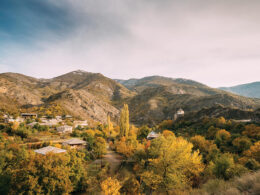
The Akhasheni microzone is situated in Inner Kakheti, along the middle stretch of the Alazani River, between its right-bank tributaries, Chermis-khevi and Papris-khevi. The vineyards here are planted at altitudes ranging from 350 to 700 metres.The microzone covers the middle and upper parts of the villages of Akhasheni and Chumlaki, as well as the Papari fields. Most of the area consists of gently to moderately sloping hills and elongated slopes, with a subtly undulating surface that descends towards the north-east. In the Akhasheni area, within the Papari Valley and the south-western part of Chumlaki, some of the soils are clay, gravelly clay, or heavy clay. In the central part of the microzone, the soils are carbonate-rich alluvial and deluvial.
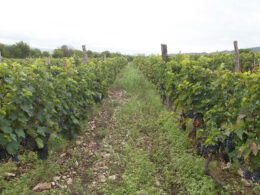
The white varieties – Rkatsiteli and Khikhvi – are grown by Marieta near the edge of Chumlaki village and the town of Gurjaani, close to the Akhasheni microzone. The Saperavi vineyard covers 4,000 square metres, with an equal area dedicated to the white varieties. She tends all three vineyards using organic and natural preparations. ‘Although the year was not a good one, I am still satisfied with this year’s harvest. We harvested all three varieties and completed the vintage successfully’, Marieta tells us as we visit her vineyard in the Papari fields.


“Our vineyards are relatively small compared to the typical size in Kakheti. Many of the surrounding vineyards are tended naturally, which is very important to us as well. The path leading here was originally quite narrow, and before we planted the vineyard, we worked the land with a horse-drawn plough, as no other machinery could be used. I enjoyed this process so much that, even though the path has since been widened, we still cultivate the soil in the vineyard using the same method today.


Our family has been involved in winemaking since 2016. We decided to plant a vineyard in the Papari fields, on land that had not been cultivated for a long time. From the very beginning, we knew we wanted to produce natural wine for family consumption. We used only organic and natural preparations to tend the vineyard. That’s how it all began, and winemaking soon developed into a family business”.
The family planted Saperavi grapes on this land in 2016, and the first wine, produced in small quantities, was made in 2020. This marked the beginning of Doctor’s Bio‑Cellar, prompting Marieta to leave her career as a doctor and dedicate herself to the vineyard.
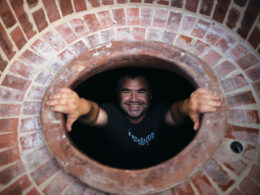
The 2025 harvest is already in qvevris, in the cellar, where she continues to nurture it. Today, she is a prominent female entrepreneur. For the third year running, her natural dry white and red wines have reached beyond Georgia’s borders, earning recognition among wine lovers and connoisseurs in Japan, England, France, and Denmark.


Doctor’s Bio‑Cellar is a small family winery, with no aim to increase production. From its three vineyards, around 5,000 bottles are produced each year. Each bottle reflects the character and distinctive qualities of its place of origin. The cellar produces Rkatsiteli (amber, dry), Khikhvi‑Rkatsiteli (amber, dry), Saperavi (red, dry, qvevri), Saperavi (red, dry, made using the European method), organic qvevri chacha (a Georgian pomace brandy), and liqueur.
The 2021 Rkatsiteli won a gold medal at the IWSC Wine Judging in Georgia; the 2020 Saperavi received an award at the Sommeliers’ Choice Awards, held as part of WinExpo 2023; and the qvevri chacha earned the Best Peasant Chacha Award at the 2023 Chacha Festival. In addition to the local market, Doctor’s Bio‑Cellar wines are available in England, Japan, and Hong Kong, in shops and bars specialising in organic and natural wines, as well as in restaurants.
Marieta oversees every step, from vineyard care to bottling the wine: Once fermentation in the qvevris is complete, on the 21st day I separate the wine from the skins and transfer it to another qvevri, where it rests for five to six months. After that, I move it to stainless steel tanks and, roughly a year and a half later, finally bottle it. As for Saperavi, in addition to the traditional method, I also produce it using the European method, resulting in a lighter-bodied wine.
Last year, we added a liqueur to Doctor’s Bio‑Cellar, aromatic and full of complex flavours, made from Saperavi grapes that I harvested late in autumn. It turned out to be such a delightful drink, that I believe it will become the signature of our winery, Marieta says.
The winery is a member of the Natural Wine Association. Like other member wineries, Doctor’s Bio‑Cellar is often represented at Raw Wine festivals in Paris, Berlin, Copenhagen, New York, and Tokyo. Last year, in Japan, a tasting of Marieta’s wines was held for representatives of the wine and HOReCa sectors as part of the Raw Wine festival.
Around 150 guests had the chance to discover her natural wines. In conversation with us, Marieta shared the positive feedback her Rkatsiteli and Saperavi have received. She also highlights the importance of being a member of WIWI (Women In Wine Industry). The association actively supports female winemakers, organising presentations and tastings of their wines abroad, which helps to raise awareness of Georgian wine and build valuable international connections.

Autumn dusk falls over the Papari fields. We head from Marieta’s vineyard towards Chumlaki, returning to the cellar, where the wines continue fermenting while vine prunings burn in the courtyard for the Mtsvadi, a traditional skewered barbecue. In Kakheti, hospitality is never complete without Mtsvadi, and the same is true at Marieta’s, where she serves this quintessential Kakhetian dish in her own unique way, naturally paired with Doctor’s Bio‑Cellar wine.