




By Nana Jojishvili | IWI Sommelier
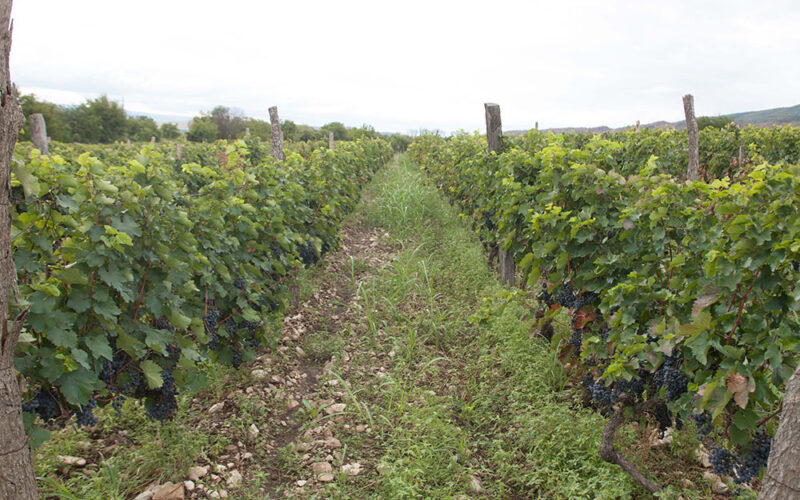
Last autumn, on my way to the village of Kharaula, I took a footpath to shorten the route. The trail led me up a mountain slope and onto the village’s main street. Beyond a collapsed wooden fence, on ’Maghlari’ (a traditional Georgian method of training vines to grow up trees), elongated, heavy clusters of grapes were just beginning to ripen. It was my first encounter with an Ajarian vineyard. The Black Sea coastline runs through three of Georgia’s wine regions—Guria, Samegrelo, and Ajara. Out of the three, Ajara is the smallest, more often associated with the sea and fun summer days than with winemaking, even among Georgians. And yet, some of the country’s oldest winemaking sites can be found both along Ajara’s coast and on the steep slopes of its mountainous interior.
The Acharistskali River splits the valley nestled behind Ajara’s warm Black Sea coast into two. The main road follows the river, winding through the mountainous districts of Keda, Shuakhevi, and Khulo before reaching the Goderdzi Pass.

Khulo, the highest settlement in mountainous Ajara, rises up to the alpine zone. In summer, shepherds bring their livestock up to the mountain peaks, staying in wooden houses until the first snow. There, they make bright, fluffy cheeses like chechili, kaimaghi, and nadughi, as soft and light as the clouds of
Beshumi (an alpine resort in Ajara).
Shuakhevi lies at the heart of mountainous Ajara. Today, small family wineries are few and far between here. One of them is the Kezheradze family’s marani (wine cellar), located in the village of Laklaketi, where I was warmly welcomed. They offered me a light, summery wine made from Chkhaveri and Tsolikouri grapes and, once again, introduced me to the rich flavours of Ajarian cuisine.
Keda is considered the main hub of winemaking in mountainous Ajara. The Communists began cultivating vines here in the 1930s, planting varieties such as Tsolikouri and Chkhaveri. By the 1950s, intensive wine production had begun. The Keda wine factory was reportedly operating at full capacity. ‘I remember in the 1970s they cleared the forests here and planted vines on the slopes using oak stakes,’ says Vazha Davitadze, who, in the village of Nenia, makes excellent wines from Tsolikouri, Chkhaveri, and local Satsuri grapes.
Before the Communist period, Ajara had gone through three difficult centuries. Being under Ottoman rule, among other things, hindered its development as a wine region. For Georgians, their relationship with the vineyard has always been deeply intertwined with religion and tradition. The culture of wine is vividly reflected in religious ceremonies. However, during Ottoman rule in Ajara, church doors were gradually closed. The presence of numerous broken-neck qvevris in old Ajarian wine cellars serves as a powerful reminder of how the local people were gradually cut off from both their faith and their winemaking heritage.

Asmat Davitadze, a lady from Shuakhevi, tells me, ‘When I was a child, we had a small vineyard in the yard. I remember how my father used to press the wine using a wooden press. I always regretted leaving the village, so every summer I would return to our old house to make walnut jam for my grandchildren. Five years ago, I began building a small marani because I wanted to bring qvevri wine back to our home. According to legend, during the invasions in Ajara, people who fled into the forest carried vine cuttings with them so that if the enemy destroyed the vineyards, they could preserve and replant them. In reality, Ajara never truly lost its connection to wine and vineyards. Production simply declined. It could be said that during Ottoman rule, winemaking and viticulture went underground.’
In R. Ramishvili’s book, I read that in the early twentieth century, during expeditions in the Machakhela valley, wild-looking cultivated vine varieties were often found trained on trees in the forest. It’s possible that the names of some native grape varieties reflect the region’s history. For example, the Ajarian variety called Tkis Vazi, meaning ‘forest vine,’ is closely linked to the legend I mentioned earlier, which feels more grounded in reality to me. The variety Tamaris Vazi is named after Queen Tamar, the 12th-century monarch. Across Ajara, you can find many bridges and fortresses bearing her name.
Winemaking Along the Black Sea Coastline
Along the Black Sea coast, in the villages of Kobuleti and Khelvachauri, unique traces of winemaking survive in the form of ancient wine presses, qvevris, and wine cellars. For example, there is an 11th-12th century wine cellar at Tskhemlara in Khelvachauri, and a 6th-century wine cellar on the Malakmadze family estate in the village of Chikuneti. Before my trip to Ajara, I reached out to Ilia Malakmadze, a professional sailor. ‘I’m out at sea,’ he told me. Due to time constraints, I wasn’t able to taste the wine from his ancient wine cellar or sample the Ajarian grape variety known as Tskhenis Dzudzu, but I look forward to visiting on my next trip.

Climatic Conditions
Ajara has two types of climate — a humid subtropical climate along the coast and a dry mountain climate inland. The coastal zone is wetter than mountainous Ajara. In the mountains, summers are cool, and winters are mild, lasting about five months. Due to these differing climatic conditions, distinct winemaking methods are used in both mountainous and lowland Ajara.
Winemaker Nugzar Khimshiashvili, originally from mountainous Ajara, harvests Chkhaveri, Tsolikouri, and Satsuri grapes in the mountains and presses them at around 800 metres above sea level, where he crafts his wines. His desire to produce qvevri wine was so strong that he overcame the challenge of high humidity by raising one side of his marani with soil to plant the qvevris.
‘In the mountains, making wine in qvevri isn’t a problem. Look, we accidentally discovered this qvevri at the edge of my vineyard while clearing a path. Unfortunately, before we noticed it, a tractor broke its belly,’ he says regretfully, showing me a photo of a large, bulbous qvevri, about his height, with a neck taller and narrower than those made today. Over the centuries, the shape of qvevris has changed several times. In recent decades, qvevri makers have favoured low-necked, conical vessels. There is also a theory that during difficult times, people covered qvevris with soil to protect them. This is how these large, beautifully decorated qvevris with ring-shaped ornaments and swan-like necks have survived to this day.
Chkhaveri of Guria and Ajara
It just so happened that I first tasted Ajarian wine in Guria, made from Chkhaveri grapes grown in Keda. The pale ruby-coloured wine had lively aromas characteristic of Chkhaveri, including barberry, cornelian cherry and rose hip, and stood out for its greater minerality. It was then that I decided to visit the mountain slopes where this wine originated.

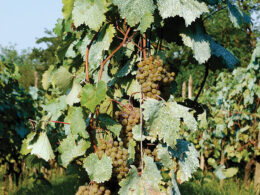
With its pink-skinned grapes, Chkhaveri is the leading variety in Ajara, while Tsolikouri leads among the whites. From Chkhaveri, winemakers produce white wines, which the French call Blanc de Noir, meaning white from red, as well as salmon-pink and pale ruby-coloured rosés.
In Guria, unlike in Ajara, Chkhaveri is more commonly fermented on the skins, which gives the wine a fuller body. When young, it has a cornelian cherry hue that gradually shifts to brick tones with age.
Chkhaveri is considered a late-ripening variety. In Guria, the harvest begins late, usually in early December. In Ajara, they say, ‘Chkhaveri must first taste the frost before it’s picked.’ When it comes to the grape’s origin, it’s best to tread carefully so as not to spark debate among winemakers from Guria and Ajara. The question of Chkhaveri’s birthplace has often come up in conversations I’ve had in both regions, which I hold equally dear. To find some clarity, I turned to several books by Georgian ampelographers. But in works published at different times by different authors, the naming and number of grape varieties often varied. That’s why I believe it’s difficult to make any firm claims.
Since antiquity, the state borders on the territory of ancient Colchis (Colchis was an ancient kingdom on the eastern Black Sea coast, in present-day western Georgia, best known from Greek mythology as the land of the Golden Fleece) have shifted many times. The migration of grape varieties is often a result of war or natural disasters, which makes it difficult to define them strictly by region. Determining the origin of a variety is a matter for genetic research and historical records.

What matters most is that the Chkhaveri grape has survived and avoided extinction. And it’s a good thing that we Georgians have two completely different stylistic expressions of Chkhaveri: the crispy, mineral wines of Ajara, and the fuller-bodied style from Guria. In the Gurian Chkhaveri, I often find aromas that take me back to childhood — the soil of spring gardens in the village and the faint smell of smoke.
Today, Ajara has limited varietal diversity. Apart from Chkhaveri and Tsolikouri, only a handful of winemakers grow other grape varieties. Hopefully, the newly established vine nursery in Keda will support the propagation and replanting of forgotten local varieties in the region.
With great affection, Winemaker Nugzar Khimshiashvili showed me the young Satsuri vines he had planted and propagated by hand, next to his wine cellar. Next spring, he plans to move them to the steep mountain slopes of Keda, aiming to have a larger Satsuri vineyard than Chkhaveri.

I first tasted Vaio’s Saperavi last year in the village of Vaio. This year, winemaker Lado Shavishvili offered me a new version, a blend with the Mekrenchkhi grape, which he cultivates in the village. (In Ajara, blends are traditionally referred to as punji.) Lado cultivates Mekrenchkhi himself in Vaio.
’This grape has fleshy pulp and large berries, we used to eat it with bread when we were kids,’ the winemaker recalls. Especially worth noting, is Shavishvili’s mastery of his Maghlari vineyards. (Maghlari is a traditional Georgian method of training vines to grow vertically up trees or tall supports, most commonly found in Guria and parts of Ajara.) The technique is labour-intensive, but its expression in the wine is remarkable. ‘Maghlari vines are difficult to manage,’ he says, ‘but once the grapes ripen, the elevation helps protect them from wild animals. Here, jackals often visit the vineyards and can destroy entire bunches of grapes that have been carefully tended all year.’
To reach the vineyards of Shervashidze and Chateau Iveri, you need to turn left from the road leading to Khulo and climb up the mountain slope. Unlike the typical Maghlari vineyards of Ajara, the vines in both vineyards are planted on gently sloping hillsides. The vineyard awakened by the rising sun from the east, basks in sunlight throughout the day, and in the evening, the cool breeze from the Black Sea flows through the valley. The slope serves as natural drainage, and good air circulation reduces the risk of diseases in the vineyard.
Earlier, I mentioned the colours of Chkhaveri. This year, I saw and tasted a light salmon-coloured Chkhaveri for the first time. Such a wine colour is rare in the Georgian market. Usually, our rosé wines tend to be darker, fuller-bodied, and rich with intense fruit aromas. The Chkhaveri from Avaliani’s winery reminded me of a French Provence–style rosé, full-bodied, crisp, with less pronounced fruit aromas, and a pale salmon hue.
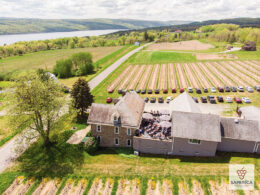
In Batumi, the capital of Ajara, and its surrounding area, you can find several wineries that buy grapes from mountainous Ajara or other regions to produce their wines. They also use grape varieties from eastern Georgia. Most of these wineries welcome local visitors. For example, Marani Marateli is located in the center of Batumi, while the Beridze family’s winery is in Makhinjauri. Zaira from the Beridze winery was the person who helped me throughout the year in discovering Ajarian winemakers. She personally leads tastings and shares Ajara’s cuisine and wine with the guests who come to visit.

I believe this form of wine production plays a vital role in developing winemaking in the region. It is precisely these wineries, which purchase grapes from local growers, that create demand for indigenous varieties like Chkhaveri and Tsolikouri. This, in turn, motivates the younger generation with the resources to tend their ancestral vineyards.
Visitors arriving on the coast can experience a completely different Ajara within an hour and a half by visiting family-run wineries. They can discover the culture of mountainous Ajara and taste local cuisine and wines on balconies perched on mountain slopes, offering stunning views of the Ajara mountains. Wine tourism is precisely what sustains important European regions such as Tuscany, Rioja, Bordeaux, and Provence.
Ajarian Cuisine
I set out for the Kezheradze family’s winery together with them. Along the way to the village of Laklaketi in Shuakhevi, we visited several wineries and, before sunset, reached their home via winding mountain roads. On the way, Gogola prepared promised Ajarian dishes — sinori, borano, kaimaghi, and sweet herishta. Dairy products hold a central place in Ajarian cuisine, and the dishes are quite hearty.
Our visit to Shuakhevi coincided with the Muslim holiday of Kurban Bayram, and the hostesses were bustling with preparations. In Ajara, it’s quite common for members of the same household to belong to two different religious traditions. They show deep respect for each other’s faiths and celebrate the holidays of both religions together. Witnessing this kind of coexistence was a profoundly moving experience for me.